
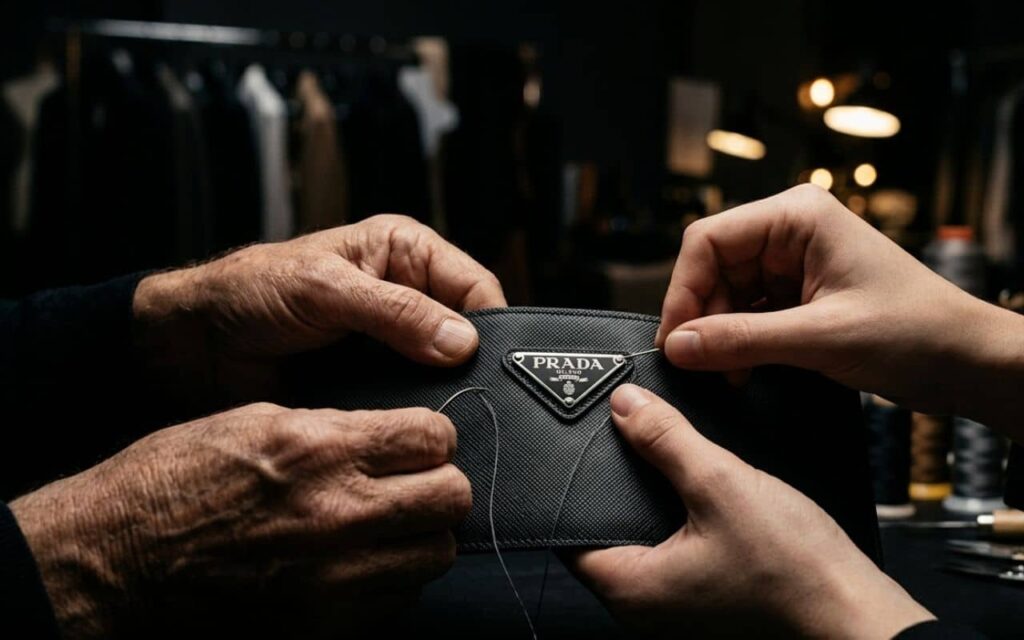
Prada was founded by Mario Prada in 1913 and has transformed from a small leather goods shop in Milan into a multibillion-dollar global empire under the leadership of Miuccia Prada and Patrizio Bertelli. However, as the founders approach their late 70s, the question of succession has become a top priority for the company’s future. Miuccia and Patrizio, who have overseen Prada’s rise, are now preparing to hand over the reins to the next generation—Miuccia’s eldest son, Lorenzo Bertelli.
The succession plan devised by Miuccia and Patrizio is systematic and aims to ensure the long-term sustainability and autonomy of the Prada brand. Lorenzo, who has held key positions in marketing and sustainability, is being groomed to lead the company. He currently holds a 50.5% stake in the family’s holding company, Ludo, which controls 80% of Prada’s shares. This move ensures that Lorenzo is in the right position to lead the company while maintaining the Bertelli family’s control over the business.
Currently, the CEO position is held by Andrea Guerra, the former CEO of Luxottica. Under Guerra’s leadership, Luxottica’s stock price nearly tripled from 2003 to 2014. The same applies to its sales performance. Previously, he worked at Merloni Elettrodomestici (now Indesit). From 2016 to 2020, Guerra served as Executive Chairman of Eataly. At Prada, Guerra is expected to help facilitate the leadership transition to the next generation.
This Prada succession story is compelling not only because it involves a generational transition within a family business, but also due to the “professional bridge” intentionally established through the figure of Andrea Guerra. In many family businesses, the most critical question isn’t who the successor is, but how the transition process unfolds. This is where Guerra’s role becomes highly strategic—one could even say he serves as both a stabilizer and an accelerator.
Miuccia Prada and Patrizio Bertelli are two powerful figures who have profoundly shaped the character of the Prada brand. Meanwhile, Lorenzo Bertelli, although already involved in managing the family business, faces challenges commonly encountered by second- or third-generation heirs: how to build his own credibility.
A direct transition from the senior generation to the successor generation is often risky. First, the founder’s influence may remain too dominant, leaving the successor feeling like a mere shadow. Second, the successor may not yet be sufficiently prepared to shoulder such a heavy responsibility. This poses a risk to the company’s future management.
This is where Guerra serves as a “buffer layer” that absorbs pressure from both sides. He is senior enough to be respected by the founding generation, yet professional enough to give Lorenzo room to grow. In other words, he is not merely an interim CEO, but a bridge between the legacy of the past and the ambitions of the future.
More Than Just Passing on a Position
Succession is often seen merely as a change in leadership. Yet, what matters most is the transfer of a strategic mindset. Guerra’s success at Luxottica demonstrates his ability to read global market dynamics, combine creativity with commercial viability, and manage expansion without sacrificing brand identity.
In the context of Prada, this is a shrewd strategy. Luxury brands thrive on creative excellence but survive on operational excellence. Guerra can help Lorenzo learn to maintain this balance—something that is often difficult to develop solely within a family environment.
Relying on a Figure vs. Relying on a System
Family businesses typically rely on individuals (a parent or founder). With the entry of a competent professional (as in Guerra’s case at Prada), the business is expected to begin building more structured processes, stronger governance, and decision-making systems that do not rely solely on senior figures. This is crucial so that when the successor eventually takes the top position, performance does not decline due to the absence of the founder. This is especially true when the professional has experience across corporations and industries, allowing them to contribute to system-building.
Credibility and Professionalism
A family business must build credibility not only within the family but also among stakeholders such as customers, suppliers, investors, and the broader community. The presence of professional management sends a strong signal that the business does not rely solely on the family’s or founder’s reputation, but also on structured, professional governance.
Indirectly, this benefits the successor. They do not need to immediately prove themselves under full pressure, as professional credibility helps maintain market trust during the transition period.