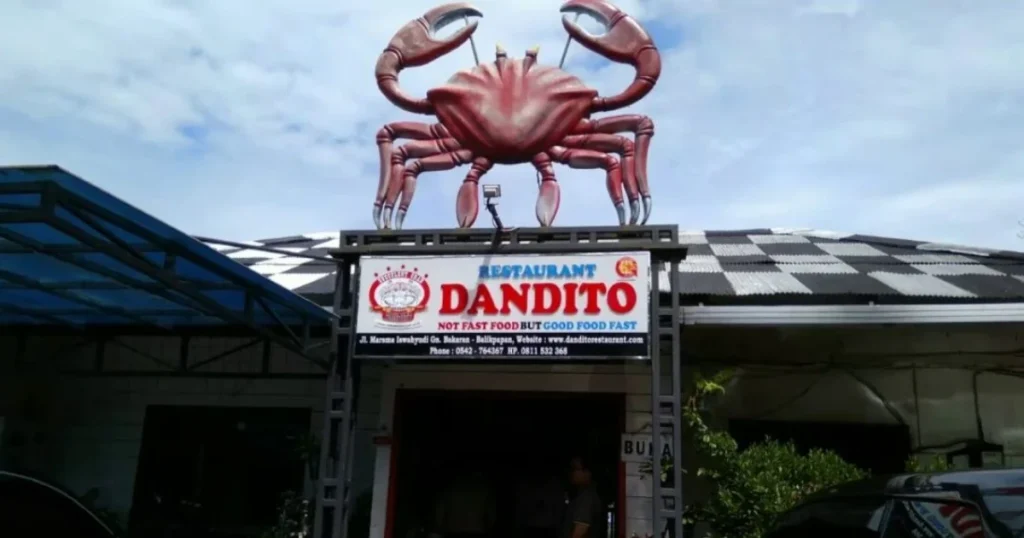
Dandito crab Balikpapan, known locally as Kepiting Dandito, is a name few visitors to East Kalimantan can miss. The restaurant has become one of the city’s culinary icons. Behind its popularity, though, lies the long journey of Rudy Setiawan. He was not the child of a wealthy entrepreneur who inherited a family business, nor did he start out with large capital. His path shows how persistence, a willingness to take risks and a sharp eye for opportunity can change a person’s life.
Quick answer: Kepiting Dandito in Balikpapan began with repeated failures and five kilograms of crab. Its founder’s story shows three things: opportunity often hides in local commodities (opportunity recognition), failure has to be learned from and not just endured, and adding outlets must be matched by organizational capability.
Data and facts: Shane and Venkataraman (2000) define entrepreneurship as the study of how, by whom and with what effects opportunities to create future goods and services are discovered, evaluated and exploited. Greiner (1972) shows that each stage of company growth ends in a management crisis that must be resolved for the business to move forward.
In 1979, at the age of 18, Rudy left Jember in East Java for Samarinda in East Kalimantan. His family’s modest finances pushed him to look for a better livelihood. He took on many kinds of work. He even slept for days at a port before a soldier helped him and took him to Balikpapan.
Dandito Crab in Balikpapan: From Construction Laborer to Restaurant Owner
In Balikpapan, Rudy worked at a cinema, but lasted only a week. He then went to Muara Badak in Kutai Kartanegara to work as a construction laborer. Another chance came when he dared to apply to an oil and gas company. He started as an errand boy and became a permanent employee in 1982.
His life stayed relatively stable until 2000. After about 18 years of service, his contract was ended in the name of efficiency. For many people, losing a job in their productive years is a heavy blow. For Rudy, it became the start of his entrepreneurial journey.
He tried many businesses, from pecel rice, steak, mixed rice and satay to groceries and clothing. None of them worked. Then a friend lent him money, rice and some basic supplies. There was also one unusual form of capital: five kilograms of crab.
That is where the idea of a crab restaurant came from. Balikpapan has plentiful crab. Rudy saw an opportunity, even though he had never cooked crab before. With his funds almost gone, he decided to give it a try.
The early days were hard. He ran one experiment after another while customer complaints kept coming. Rudy did not give up. He kept refining his seasoning until he found Dandito’s signature sauce, a blend of tomato, ginger, palm sugar, onion and chili with a sour, sweet and spicy taste. Slowly, the dish found its fans.
Kepiting Dandito grew into a widely known culinary destination. The restaurant was reportedly recognized as one of Balikpapan’s best taxpayers, and its signature dish was once served at the State Palace during Indonesian Independence Day celebrations.
Persistence and an Eye for Opportunity
Rudy’s journey holds some important lessons. First, entrepreneurial success does not always start with a spectacular business idea. Sometimes opportunity sits close to everyday life.
Rudy did not invent crab as a new product. He did not discover a revolutionary food-processing technology either. He simply saw the potential of a local commodity and turned it into a product with its own character.
In entrepreneurship this is known as opportunity recognition: the ability to spot opportunities in the surrounding conditions and available resources. This skill often matters more than having large capital.
Second, failure is not the end of an entrepreneur’s journey. Before he found a business that worked, Rudy tried many ventures and failed repeatedly. Yet he kept going and looked for alternatives.
Still, there is a difference between simply refusing to quit and the ability to learn from failure. Refusing to quit keeps a person trying, while learning helps them find a better way. In Rudy’s case, the repeated experiments with the crab sauce show how much the learning process matters.
Is your business getting overwhelmed as it grows? Business consulting can help you build operating systems, clear authority and manager capability before you add outlets or branches. Talk to the team at THE JAKARTA CONSULTING GROUP (JCG) on WhatsApp at +62 814-1056-3419
When Growth Creates Problems
Rudy once ran four outlets in Balikpapan. He later decided to merge them into one because he was overwhelmed managing the operations.
That decision teaches something important. Business growth is often measured by higher revenue, more outlets, more employees or a wider market. The bigger the business, the more successful the entrepreneur is assumed to be.
But growth does not always mean progress. The bigger a business gets, the more complex it is to manage. The owner can no longer supervise every activity directly. Product quality has to be protected at every outlet, staff have to be managed, inventory has to be controlled, and service standards have to stay consistent.
The problem is that the ability to manage four outlets at once may not be enough. The business needs operating systems, work procedures, clear division of authority and managers who can make decisions without always waiting for the owner’s instructions. In strategic management, this relates to the gap between business growth and organizational capability.
Seen this way, Rudy’s decision to reduce the number of outlets can be read as an effort to regain control of the business. Rather than keep many outlets and struggle to maintain quality and operations, it was better to focus on one.
Expanding into New Markets Does Not Always End in Success
The next challenge came when Rudy tried to take Dandito beyond Balikpapan. He opened a branch in Bali, but it lasted only three years before closing at a loss.
The experience shows that success in one market cannot automatically be copied in another. A restaurant with a strong reputation in Balikpapan may not be as well known or as appealing to consumers in Bali. Customer characteristics, competition, operating costs, availability of ingredients and brand strength in the new market all have to be considered.
A basic question needs an answer before any expansion: does the business’s strength come from systems already in place, or does it still depend heavily on the founder’s presence and direct involvement?
If a restaurant’s success depends largely on the owner’s ability to protect the taste, serve customers and supervise staff, opening a new branch without adequate systems risks moving the same problem to a different location.
FAQ
1. What is opportunity recognition in entrepreneurship?
The ability to spot opportunities in the surrounding conditions and available resources. In the Dandito story, the opportunity was the plentiful crab in Balikpapan.
2. Why can expansion into a new market fail?
Success in one market cannot automatically be copied in another. Customer characteristics, competition, operating costs, ingredient availability and brand strength in the new market all matter.
3. When is a business ready to open a new branch?
When its strength comes from systems already in place rather than the founder’s direct presence. Signs include work procedures, clear division of authority and managers who can decide without waiting for the owner.
Related Posts:
- Lonely Owner Syndrome in Family Business
- The Right Leader at the Wrong Time: A Dilemma
- The Incompetent Heir: A Time Bomb in Family Business
References
- Indonesia.travel. Dandito (Balikpapan). https://www.indonesia.travel/id-id/travel-ideas/gastronomy/dandito/
- Shane, S., & Venkataraman, S. (2000). The Promise of Entrepreneurship as a Field of Research. Academy of Management Review, 25(1), 217–226. https://pdp.sjsu.edu/people/john.estill/courses/158-s15/The%20Promise%20of%20Entrepreneurship%20as%20a%20Field%20of%20Study.pdf
- Greiner, L. E. (1972). Evolution and Revolution as Organizations Grow. Harvard Business Review, 50(4), 37–46. https://naturalsciences.ucmerced.edu/sites/g/files/ufvvjh1296/f/page/documents/evolution_and_revolution_as_organizations_grow.pdf
Ready to grow your business without losing control? We help entrepreneurs and family businesses prepare strategy, systems and leadership for the next phase of growth. Talk to the team at THE JAKARTA CONSULTING GROUP (JCG) on WhatsApp at +62 814-1056-3419