
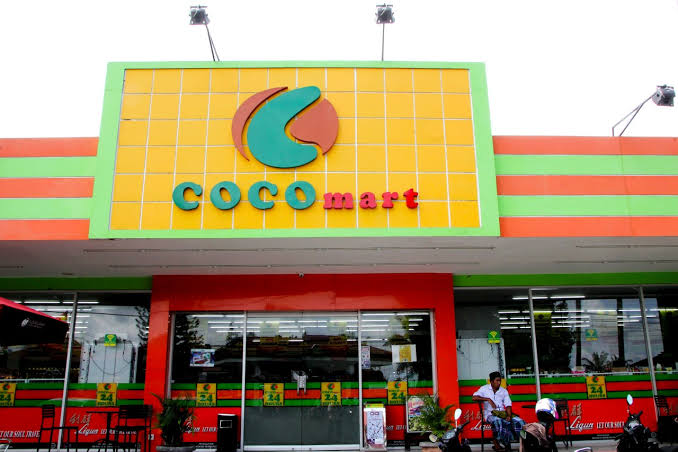
This is the story of I Nengah Natyanta, founder and owner of Coco Group.
He started his business from scratch, beginning with a small shop on Taman Griya Nusa Dua street, South Kuta District, Badung in 2006. From there, his retail business has grown to what it is today.
He used to be an ordinary employee at the Grand Hyatt Bali Hotel for 12 years, from 1992 to 2004. He spent six years as a squad member and the next six years as a waiter. The life of a hotel employee is not as glamorous as that of its guests. In 1998, Natya’s wife suggested that they start their own business. So they opened a small shop.
Coco Group’s Journey
In 2002, Natya opened a restaurant called Coco Bistro. The reason for the name was quite simple. At the restaurant, he sold fresh coconut water.
However, the Bali II bombings in Kuta (Kuta District, Badung) and Jimbaran Village (South Kuta District, Badung) on October 1, 2005, caused Natyanta’s business to falter. Nevertheless, Natyanta did not give up.
The tourism business in Bali was fluctuating, so he decided to leave the hotel and focus on entrepreneurship. Natya’s business turned out to be successful. In 2006, Natya and his wife took the plunge and established the first Coco Mart outlet. The initial capital was only Rp 15 million from Natya’s salary and tips he had saved while working at the hotel. Since then, Natya has continued to expand his business, which is still growing today.
Natyanta’s choice turned out to be the right one. The Coco Mart he started grew rapidly. Natyanta continued to expand his business, and now his retail business has grown to hundreds of outlets spread across Bali and NTB, employing more than 2,000 employees.
Coco Mart is part of the Coco Group. The company is committed to providing quality products at affordable prices and offering a comfortable shopping experience for customers. The concept is “Cheap, Complete, and Comfortable,” reflecting friendly prices, a complete range of products, and a comfortable shopping experience.
In addition to Coco Mart, Coco Group also manages other business units such as Coco Express and Coco Supermarket, which are spread across various strategic locations in Bali. Coco Group offers opportunities for the public to own and operate Coco Mart outlets through a partnership program, with full support in terms of branding, supplier networks, and information technology. In addition, there are also hotel and villa businesses as well as distribution services. According to Coco Group’s official website this growth is clear evidence that with commitment, perseverance, and strong values of integrity, local Bali businesses are able to compete at the national and even international levels.
Leadership Philosophy

As the founder, I Nengah Natyanta is known as a visionary and innovative leader. He has strong managerial skills in developing business strategies and ensuring that every branch of the Coco Group runs efficiently, modernly, and is oriented towards providing the best service for customers. Under his leadership, the company continues to adapt to the times, implementing professional management systems and upholding high standards of quality and consumer trust.
Meanwhile, his wife, Ni Ketut Siti Maryati, plays an important role in strengthening the company’s foundation through a humanistic approach and a focus on human resource development. She believes that the company’s success begins with the welfare and loyalty of its employees. Therefore, various training programs, local workforce empowerment, and social activities are the focus of her leadership.
Both founders share the same philosophy: business is not only about profit, but also about social contribution and responsibility. Coco Group Bali has grown with the spirit of supporting regional progress, strengthening the local economy, and becoming a platform for the younger generation of Bali to develop through employment opportunities and continuous learning.
Paradox
Bali is a paradox. On the one hand, it offers tremendous economic opportunities through tourism. On the other hand, its dependence on external factors—foreign tourists, security issues, pandemics, and global crises—makes it a business region that is highly vulnerable to shocks.
Natyanta understands this paradox not from textbooks, but from his direct experience as a hotel employee for more than a decade.
He saw firsthand how the glitz and glamour of the hospitality industry did not always correlate with the well-being of its workers. This is where the seed of an important realization was planted: economic stability cannot depend solely on elite tourism.
Many narratives describe Coco Mart as the product of perseverance and courage. This is certainly true. However, what is rarely discussed is the accuracy of its business model choice.
The transition from a restaurant (Coco Bistro) to a local convenience store reflects a deep understanding of Bali’s market behavior: tourism is seasonal and fluctuating. The daily needs of the local community are constant. Retail for basic needs is more crisis-resistant than hospitality.
The 2005 Bali bombings are often positioned as a mental test. In fact, they also served as a “shock test” for business models. Many hospitality players collapsed. Coco Mart was born after that—a signal that Natyanta did not just survive, but learned from the crisis. This is where Coco Mart became more than just a store: it was a structural answer to Bali’s economic uncertainty.
“Cheap, Complete, Convenient”: Simple but Disciplined
Coco Mart’s slogan sounds generic. However, in retail practice, simplicity actually requires high organizational discipline. Cheap means supply chain efficiency. Complete means neat inventory management. Convenient means consistent service across outlets.
Ni Ketut Siti Maryati’s role in this story is not merely complementary. She represents a balance of leadership that is often absent in fast-growing businesses.
If Natyanta plays the role of strategic direction and expansion, then a humanistic approach to employees becomes the foundation of internal stability. In a labor-intensive retail organization, employee loyalty is not a moral slogan—it is an operational asset.
However, the biggest challenge lies here: how to maintain the “big family” approach as the organization becomes more complex? This is the classic dilemma of local businesses moving up the ladder: family values versus the demands of professionalism. Coco Group has so far been able to navigate this tension, but the risks are still real.
More Than a Success Story
If this story is only read as an inspirational tale, we miss its most important essence. Coco Group and Hotel Natya offer several important lessons. First, entrepreneurship is about reading risk structures, not just courage. Second, local businesses can grow large if they are able to break out of single dependencies. Third, cultural values are a strength, but they must be translated into systems. Fourth, rapid growth requires a transition from intuitive to institutional leadership.
#Coco Group #I Nengah Natyanta #Bali #tourism business #Coco Mart #visionary #innovative #human resource development #market behavior #retail #leadership #professionalism